
 ,
Atiqul Maula Omar Ibrahim Shamsi,
Mohammad Sharif Hossain,
Md. Ziaur Rahman,
Syeda Tashfia Jahan,
Md. Insanul Alam,
Mahmudul Hasan Chowdhury,
Ahsan Ahmed
,
Atiqul Maula Omar Ibrahim Shamsi,
Mohammad Sharif Hossain,
Md. Ziaur Rahman,
Syeda Tashfia Jahan,
Md. Insanul Alam,
Mahmudul Hasan Chowdhury,
Ahsan Ahmed
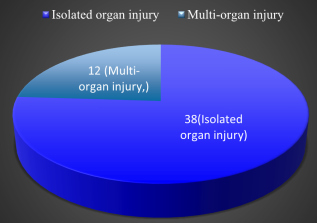
Background: Blunt abdominal trauma (BAT) is a common cause of intra-abdominal injuries and poses significant diagnostic challenges. Laboratory and imaging investigations are essential in guiding the management of these patients. Objective: This study aimed to evaluate the diagnostic significance of laboratory tests in correlation with findings from exploratory abdominal surgery following trauma. Methods: This descriptive cross-sectional study was conducted in the Department of Surgery, Rangpur Medical College and Hospital, Rangpur, Bangladesh, from July 2020 to December 2020. A total of 50 patients diagnosed with blunt abdominal trauma and requiring exploratory laparotomy were included in the study. Results: The majority of patients were aged 31–40 years (42%) with a male predominance (70%). Abdominal pain was the most common presenting symptom (100%), followed by abdominal distension (76%) and vomiting (24%). Clinical examination revealed tenderness in 90%, guarding/rigidity in 78%, and rebound tenderness and absent bowel sounds in 70% of patients. Laboratory abnormalities included deranged INR in 74%, prolonged APTT in 70%, elevated AST in 34%, ALT in 30%, and raised amylase and lipase in 48% of patients. Imaging detected free fluid on USG in 80% and haemoperitoneum on CT in 94% of cases. Small bowel was the most commonly injured organ (54%), followed by liver (20%), spleen (16%), mesentery (12%), duodenum (10%), colon (6%), and stomach (4%). Most injuries were isolated (76%), with grade II small bowel and duodenal injuries predominating. Patients aged 18–40 years exhibited the highest frequency of biochemical and imaging abnormalities, correlating with small bowel injuries (P < 0.00001). Conclusion: Laboratory and imaging investigations provide valuable diagnostic support in BAT but should complement clinical evaluation. Younger patients are at higher risk for small bowel injuries and exhibit more pronounced biochemical derangements. Early recognition and correlation with surgical findings are crucial to improve outcomes.
| Published in | Journal of Surgery (Volume 13, Issue 6) |
| DOI | 10.11648/j.js.20251306.11 |
| Page(s) | 152-161 |
| Creative Commons |
This is an Open Access article, distributed under the terms of the Creative Commons Attribution 4.0 International License (http://creativecommons.org/licenses/by/4.0/), which permits unrestricted use, distribution and reproduction in any medium or format, provided the original work is properly cited. |
| Copyright |
Copyright © The Author(s), 2025. Published by Science Publishing Group |
Blunt Abdominal Trauma, Intra-abdominal Injury (Iai), Laparotomy, Organ Injury Scaling
Variables | Number | Percentage (%) |
|---|---|---|
Age (years) | ||
18–30 | 15 | 30 |
31–40 | 21 | 42 |
41–50 | 7 | 14 |
51–60 | 4 | 8 |
>60 | 3 | 6 |
Mean ± SD | 39.74 ± 13.9 | |
Sex | ||
Male | 35 | 70 |
Female | 15 | 30 |
Symptoms | ||
Abdominal pain | 50 | 100 |
Abdominal distension | 38 | 76 |
Vomiting (non-bloody) | 12 | 24 |
Vomiting (Blood mixed) | 2 | 4 |
Urinary retention | 9 | 18 |
Hematuria | 10 | 20 |
Signs | ||
Abdominal distension | 28 | 56 |
Abdominal bruise (London’s sign) | 7 | 14 |
Abdominal tenderness | 45 | 90 |
Rebound tenderness | 35 | 70 |
Muscle guard/rigidity | 39 | 78 |
Obliteration of liver dullness | 29 | 58 |
Absence of bowel sound | 35 | 70 |
Tachycardia | 29 | 58 |
Parameters | Number | Percentage (%) |
|---|---|---|
Hemoglobin level (gm/dl) | ||
>10 | 5 | 10 |
9–9.99 | 25 | 50 |
8–8.99 | 10 | 20 |
7–7.99 | 8 | 16 |
≤6.00 | 2 | 4 |
Mean ± SD (gm/dl) | 9.22 ± 1.01 | |
Coagulation profile (INR) | ||
<1.5 | 13 | 26 |
>1.5 | 37 | 74 |
Coagulation profile (APTT) | ||
Normal (≤36 sec) | 15 | 30 |
Prolonged (>36 sec) | 35 | 70 |
AST level | ||
Normal | 33 | 66 |
Abnormal | 17 | 34 |
ALT level | ||
Normal | 35 | 70 |
Abnormal | 15 | 30 |
Serum amylase level | ||
Normal | 26 | 52 |
Raised | 24 | 48 |
Serum lipase level | ||
Normal | 26 | 52 |
Raised | 24 | 48 |
Investigation | Number | Percentage (%) |
|---|---|---|
Plain X-ray (n = 50) | ||
Gas under right dome of diaphragm | 30 | 60 |
Dilated bowel loops | 6 | 12 |
Air-fluid level | 2 | 4 |
Ultrasonography (USG) (n = 50) | ||
Pleural effusion | 3 | 6 |
Free fluid | 40 | 80 |
Hemothorax | 1 | 2 |
Intra-abdominal injury detected | 13 | 26 |
Hollow organ injury | 3 | 14 |
Liver injury | 6 | 28 |
Spleen injury | 4 | 18 |
CT scan (n = 36) | ||
Haemoperitoneum | 34 | 94.44 |
Hemopneumoperitoneum | 25 | 69.44 |
Intra-abdominal injury detected | 21 | 58.33 |
Hollow organ injury | 3 | 14.21 |
Liver injury | 10 | 47.61 |
Spleen injury | 8 | 38.09 |
Organ | Number | Percentage (%) |
|---|---|---|
Stomach | 2 | 4 |
Duodenum | 5 | 10 |
Pancreas | 1 | 2 |
Small intestine | 27 | 54 |
Spleen | 8 | 16 |
Liver | 10 | 20 |
Colon | 3 | 6 |
Mesenteric injury | 6 | 12 |
Organ | Number | Percentage (%) |
|---|---|---|
Small bowel (n = 27) | ||
Grade I | 0 | 0 |
Grade II | 20 | 74.07 |
Grade III | 3 | 11.11 |
Grade IV | 2 | 7.44 |
Grade V | 2 | 7.44 |
Liver (n = 10) | ||
Grade I | 0 | 0 |
Grade II | 2 | 20 |
Grade III | 5 | 50 |
Grade IV | 3 | 30 |
Grade V | 0 | 0 |
Spleen (n = 8) | ||
Grade I | 2 | 25 |
Grade II | 2 | 25 |
Grade III | 1 | 12.5 |
Grade IV | 3 | 37.5 |
Grade V | 0 | 0 |
Duodenum (n = 5) | ||
Grade I | 0 | 0 |
Grade II | 4 | 80 |
Grade III | 1 | 20 |
Grade IV | 0 | 0 |
Grade V | 0 | 0 |
Colon (n = 3) | ||
Grade I | 0 | 0 |
Grade II | 3 | 100 |
Grade III | 0 | 0 |
Grade IV | 0 | 0 |
Grade V | 0 | 0 |
Stomach (n = 2) | ||
Grade I | 0 | 0 |
Grade II | 2 | 100 |
Grade III | 0 | 0 |
Grade IV | 0 | 0 |
Grade V | 0 | 0 |
Age (years) | AST n=17 | ALT n=15 | Serum amylase n=26 | Serum lipase n=26 | INR n=37 | APTT n=35 | USG | CT scan |
|---|---|---|---|---|---|---|---|---|
18–30 (n=15) | 2 | 2 | 7 | 7 | 11 | 10 | 13 | 11 |
31–40 (n=21) | 10 | 9 | 13 | 13 | 17 | 16 | 19 | 16 |
41–50 (n=7) | 2 | 2 | 2 | 2 | 5 | 5 | 5 | 5 |
51–60 (n=4) | 2 | 1 | 3 | 3 | 3 | 3 | 2 | 3 |
>60 (n=3) | 1 | 1 | 1 | 1 | 1 | 1 | 1 | 1 |
Age (years) | Stomach n=2 | Duodenum n=5 | Small bowel n=27 | Pancreas n=1 | Liver n=10 | Spleen n=8 | Colon n=3 | P-value |
|---|---|---|---|---|---|---|---|---|
18–30 (n=15) | 1 | 1 | 9 | 0 | 2 | 1 | 1 | <0.00001 |
31–40 (n=21) | 1 | 2 | 12 | 1 | 6 | 3 | 2 | <0.00001 |
41–50 (n=7) | 0 | 1 | 3 | 0 | 1 | 2 | 0 | 0.02981 |
51–60 (n=4) | 0 | 0 | 2 | 0 | 0 | 2 | 0 | <0.00001 |
>60 (n=3) | 0 | 1 | 1 | 0 | 1 | 0 | 0 | <0.00001 |
BAT | Blunt Abdominal Trauma |
IAI | Intra-abdominal Injuries |
CT | Computed Tomography |
USG | Ultrasonography |
| [1] | Hoyt BD, Coimbra R, Winchell RJ. Management of acute trauma. In: Townsend CM Jr, Beauchamp RD, Evers BM, Mattox KL (eds). Sabiston Textbook of Surgery: The biological basis of modern surgical practice. 16th ed. Philadelphia, PL, USA: Saunders; 2001: 311-43. |
| [2] | Sarker MM, Sarker MK, Perveen NA. Intra-abdominal injuries following blunt abdominal trauma-analysis of 100 cases. The Journal of Teachers Association RMC, Rajshahi. 2015; 28(2): 07-14. |
| [3] | Gad MA, Saber A, Farrag S, Shams ME, Ellaban GM. Incidence, pattern and factors predicting mortality of abdominal injuries in trauma patients. North Am J Med Sci 2012; 4: 129-34. |
| [4] | Krishnappa N, Khan A, Sakranalk S. An analysis of injury patterns of abdominal trauma in patients attending surgical emergency department of rural hospital, Karnataka, India. Int Surg J. 2017; 4(11): 3736-39. |
| [5] | Hughes TM, Elton C. The pathophysiology and management of bowel and mesenteric injuries due to blunt trauma. Injury 2002; 33(4): 295-302. |
| [6] | Poletti PA, Kinkei K, Vermulen B. Blunt Abdominal Trauma: should US be used to detect both free fluid and organ injury? Radiology 2003; 227: 95-103. |
| [7] | Christiano JG, Tummers M, Kennedy A. Clinical significance of isolated intraperitoneal fluid on computed tomography in paediatric blunt abdominal trauma. J Pediatr Surg Jun 2009; 44(6): 1242-48. |
| [8] | Lakshmi AV, Ratnakumari BV, Bharath YN. Our experience with blunt abdominal trauma. J Evid Based Med Healthc. 2016; 3(100): 5536-39. |
| [9] | Jones EL, Stovall RT, Jones TS, Bensard DD, Burlew CC, Jhonson JI et al. Intra-abdominal injury following blunt trauma becomes clinically apparent within 9 hours. J Trauma Acute Care Surg. 2014; 76(4): 1020-23. |
| [10] | Beck D, Marley R, Salvador A, Muakkassa F. Prospective study of the clinical predictors of a positive abdominal computed tomography in blunt trauma patients. J Trauma. 2004; 57(2): 296-300. |
| [11] | Poletti PA, Minvis SE, Shanmuganathan K, Takada T, Killeen KL, Permutter D et al. Blunt abdominal trauma patients: can organ injury be excluded without performing computed tomography? J Trauma. 2004; 57(5): 1072-81. |
| [12] | Mosaddegh R, Nabi S, Daei S, Mohammadi F, Masoumi G, Vaziri S. Combination of liver enzymes, amylase and abdominal ultrasound tests have accepted diagnostic values as an alternative test for abdominopelvic CT scan in blunt abdominal trauma. Open Access Emergency Medicine 2019; 11: 205-10. |
| [13] | Yadav SK, Sharma R, Sinha DK, Kumar S. Characteristics hollow viscus injury following blunt abdominal trauma; a single centre experience from Eastern India. Bull Emerg Trauma. 2014; 4: 156-60. |
| [14] | Lee BC, Ormsby EL, McGahan JP, Melendres GM. The utility of sonography for the triage of blunt abdominal patients to exploratory laparotomy. Am J Roentgenol 2007; 188(2): 415-21. |
| [15] | Fakhry SM, Watt DD, Luchette FA. Current diagnostic approaches lack in the diagnosis of perforated blunt small bowel injuries: analysis of 275,557 trauma admission from the East multi-institutional HVI trial. J Trauma. 2003; 54: 253-8. |
| [16] | Sharif A, Akhtar T, Zia N. Bowel injury in blunt abdominal trauma-Role of serial focused assessment sonography for trauma scan. Journal of Rawalpindi Medical College (JRMC). 2015; 19(2): 129-32. |
| [17] | Latifi R, Ivatury RR, Malhotra AK. Blunt abdominal trauma: evaluation and indication for laparotomy. Scandinavian journal of Surgery 2002; 91: 52-57. |
| [18] | Pimentel SK, Nars A, Collaco IA. Risk factors for mortality in blunt abdominal trauma with surgical approach. Rev. Col Bras. Cir 2015; 42(4): 259-64. |
| [19] | McKenny M, Lentz K, Nunez D. Can ultrasound replace DPL in assessment of blunt trauma. J Trauma 1994; 37: 439-41. |
| [20] | Rajkumar PN, Kumar KTR, Deepak G. Challenges in management of blunt abdominal trauma: a prospective study. Int Surg J 2018: 5: 3298-3304. |
| [21] | Dauterive AH, Flanchaum L, Cox EF. Blunt intestinal injury: a modern-day review. Ann Surg. 1985; 201: 198-203. |
| [22] | Munns J, Richardson M, Hewett P. A review of intestinal injury from blunt abdominal trauma. Aust NZJ Surg. 1995; 65(12): 857-60. |
| [23] | Parvez A, Basir A, Cheema MU. Blunt trauma abdomen- incidence of abdominal visceral injuries. P J M H S 2008; 2(3): 86-8. |
| [24] | Patel P, Gadhavi J, Parmar H. A study of blunt and penetrating abdominal trauma, its various pattern of injuries and its management. Int J Med Sci Public Health 2016; 5(7): 1309. |
| [25] | Amuthan J, Vijay A, Pradeep C, Anandan H. A clinical study of blunt injury abdomen in a tertiary care hospital. Int J Sci Stud 2017; 5(1): 108-112. |
| [26] | Arif M, Maqsood M, Shaneen A. Pattern of abdominal organ injuries in non-fatal Blunt Trauma; P J M H S 2014; 8(1): 105-09. |
| [27] | Madhumita Mukhopadhyay. Intestinal Injury from Blunt Abdominal Trauma: A Study of 47 Cases O M J 2009; 24: 256-9. |
| [28] | Umare GM, Sherkar N, Motewar A. Study of clinical profile and management of blunt abdominal trauma. Int Jou of Cont Medi Res 2018; 5(1): 4-9. |
| [29] | Vashistha R, Bansal H, Datey S, Charles N, Lazarus A, Gadodia M. Study of the clinical profile of blunt abdominal trauma at a tertiary care centre of central India. Jou of Evo of Med and Dent Sci 2015; 4(93): 15839-42. |
| [30] | Abri B, Shams-Vahdati S, Paknezhad S, Sepehri-Majd P, Alizadeh S. Blunt abdominal trauma and organ damage and its prognosis. J Anal Res Clin Med 2016; 4(4): 228-32. |
| [31] | Sisodiya S, Malpani P. A retrospective study of blunt trauma abdomen in a tertiary center in central India: evaluation, management and outcome. Int Surg J 2020; 7: 2696-701. |
| [32] | Rajan, Chhabra A. Clinical profile of blunt trauma abdomen at a tertiary hospital of north India. Int Jou of Med and Hea Res 2018; 4(12): 113-6. |
| [33] | Siddique MAB, Rahman MK, Hannan ABMA. Study on Abdominal Injury: An Analysis of 50 Cases. T A J 2004; 17(2): 84-8. |
| [34] | Davis JJ, Cohn I Jr., Nance FC. Diagnosis and Management of Blunt Abdominal Trauma. Ann Surg 1976; 183(6): 672-7. |
| [35] | Mansour DA, Eisha H AA, Asaad AE. Validation of revised trauma score in the emergency department of Kasr Al Ainy. The Egyptian Journal of Surgery 2019; 38(4): 679-84. |
| [36] | Zaki YK, Bilal SIA, Matar MM, Zaki DMN. Clinical and Laboratory Evaluation of Blunt Trauma Patients for the Early Diagnosis of Intra-Abdominal Injuries. Ain Shams Journal of Forensic Medicine and Clinical Toxicology 2021; 36: 61-74. |
| [37] | Musalar E, Ersel M, Akarca FK, Kıyan GS, Can O. The predictive value of biochemical parameters in evaluating patients with abdominal trauma: The new scoring system, Turkish Journal of Emergency Medicine 2017; 17: 48-55. |
| [38] | Elbaih AH, Ali MA, Abozaid A, Saady BM, Farrag SH. Role of elevated liver transaminase enzymes in diagnosis of liver injury in cases after abdominal trauma. Int Surg J 2016; 3: 1184-92. |
| [39] | Singh RP, Garg N, Nar AS, Mahajan A, Mishra A, Singh J. Role of amylase and lipase levels in diagnosis of blunt trauma abdomen. Jou of Clin and Dia Res 2016; 10(2): 20-3. |
| [40] | Farkouth E, Wasserf R, Atlas H. Importance of the serum amylase level in patients with blunt abdominal trauma. Can J Surg. 1982; 25: 626-28. |
| [41] | Srivastava S. Comparative study of CT and ultrasonography in Blunt Abdominal Trauma. J M S C R 2018; 6(2): 405-17. |
| [42] | Makama JG, Garba ES, Joshua IA. The value of ultrasound in the management of blunt abdominal trauma in Zaria, Nigeria. Arch Int Surg 2012; 2: 96-100. |
| [43] | Khanna R, Khanna S, Singh P, Puneet, Khanna AK. Spectrum of blunt abdominal trauma in Varanasi. Quart J Surg Sciences 1999; 35(1): 25-8. |
| [44] | Sarma KD, Mottaquin MM. Visceral injuries in blunt abdominal trauma. J M S C R 2016; 4(7): 11661-8. |
| [45] | Ayoade BA, Thanni LO, Shonoiki-Oladipupo O. Abdominal injuries in Olabisi Onabanjo University teaching hospital Sagamu, Nigeria: Pattern and Outcome; Nigerian Journal of Orthopaedics And Trauma 2006: 5(2): 45-9. |
| [46] | Ahmad R, Rafi Y, Sohali R, Javed M, Noor M, Abid KJ. A Pattern of Abdominal Organs Injuries in Blunt Trauma and Their Outcome. P J M H S 2013; 7(3): 815-9. |
| [47] | Hussain MI, Al-Akeely MH, Mohammed AA. Operative management of liver trauma. A 10-year experience in Riyadh, Saudi Arabia. Saudi J Med 2009; 30(7): 942-6. |
| [48] | Koca B, Karabulut K, Ozbalci GS, Polat AK, Tarım IA, Gungor BB et al. Is it possible to use transaminases for deciding on surgical or non-operative treatment for blunt liver trauma? Wien Klin Wochenschr 2015; 127: 954-8. |
APA Style
Islam, M. T., Shamsi, A. M. O. I., Hossain, M. S., Rahman, M. Z., Jahan, S. T., et al. (2025). Diagnostic Significance of Laboratory Tests in Correlating with Findings of Exploratory Abdominal Surgery Following Trauma. Journal of Surgery, 13(6), 152-161. https://doi.org/10.11648/j.js.20251306.11
ACS Style
Islam, M. T.; Shamsi, A. M. O. I.; Hossain, M. S.; Rahman, M. Z.; Jahan, S. T., et al. Diagnostic Significance of Laboratory Tests in Correlating with Findings of Exploratory Abdominal Surgery Following Trauma. J. Surg. 2025, 13(6), 152-161. doi: 10.11648/j.js.20251306.11
AMA Style
Islam MT, Shamsi AMOI, Hossain MS, Rahman MZ, Jahan ST, et al. Diagnostic Significance of Laboratory Tests in Correlating with Findings of Exploratory Abdominal Surgery Following Trauma. J Surg. 2025;13(6):152-161. doi: 10.11648/j.js.20251306.11
@article{10.11648/j.js.20251306.11,
  author = {Md. Toufiqul Islam and Atiqul Maula Omar Ibrahim Shamsi and Mohammad Sharif Hossain and Md. Ziaur Rahman and Syeda Tashfia Jahan and Md. Insanul Alam and Mahmudul Hasan Chowdhury and Ahsan Ahmed},
  title = {Diagnostic Significance of Laboratory Tests in Correlating with Findings of Exploratory Abdominal Surgery Following Trauma},
  journal = {Journal of Surgery},
  volume = {13},
  number = {6},
  pages = {152-161},
  doi = {10.11648/j.js.20251306.11},
  url = {https://doi.org/10.11648/j.js.20251306.11},
  eprint = {https://article.sciencepublishinggroup.com/pdf/10.11648.j.js.20251306.11},
  abstract = {Background: Blunt abdominal trauma (BAT) is a common cause of intra-abdominal injuries and poses significant diagnostic challenges. Laboratory and imaging investigations are essential in guiding the management of these patients. Objective: This study aimed to evaluate the diagnostic significance of laboratory tests in correlation with findings from exploratory abdominal surgery following trauma. Methods: This descriptive cross-sectional study was conducted in the Department of Surgery, Rangpur Medical College and Hospital, Rangpur, Bangladesh, from July 2020 to December 2020. A total of 50 patients diagnosed with blunt abdominal trauma and requiring exploratory laparotomy were included in the study. Results: The majority of patients were aged 31–40 years (42%) with a male predominance (70%). Abdominal pain was the most common presenting symptom (100%), followed by abdominal distension (76%) and vomiting (24%). Clinical examination revealed tenderness in 90%, guarding/rigidity in 78%, and rebound tenderness and absent bowel sounds in 70% of patients. Laboratory abnormalities included deranged INR in 74%, prolonged APTT in 70%, elevated AST in 34%, ALT in 30%, and raised amylase and lipase in 48% of patients. Imaging detected free fluid on USG in 80% and haemoperitoneum on CT in 94% of cases. Small bowel was the most commonly injured organ (54%), followed by liver (20%), spleen (16%), mesentery (12%), duodenum (10%), colon (6%), and stomach (4%). Most injuries were isolated (76%), with grade II small bowel and duodenal injuries predominating. Patients aged 18–40 years exhibited the highest frequency of biochemical and imaging abnormalities, correlating with small bowel injuries (P Conclusion: Laboratory and imaging investigations provide valuable diagnostic support in BAT but should complement clinical evaluation. Younger patients are at higher risk for small bowel injuries and exhibit more pronounced biochemical derangements. Early recognition and correlation with surgical findings are crucial to improve outcomes.},
 year = {2025}
}
TY  - JOUR
T1  - Diagnostic Significance of Laboratory Tests in Correlating with Findings of Exploratory Abdominal Surgery Following Trauma
AU  - Md. Toufiqul Islam
AU  - Atiqul Maula Omar Ibrahim Shamsi
AU  - Mohammad Sharif Hossain
AU  - Md. Ziaur Rahman
AU  - Syeda Tashfia Jahan
AU  - Md. Insanul Alam
AU  - Mahmudul Hasan Chowdhury
AU  - Ahsan Ahmed
Y1  - 2025/12/09
PY  - 2025
N1  - https://doi.org/10.11648/j.js.20251306.11
DO  - 10.11648/j.js.20251306.11
T2  - Journal of Surgery
JF  - Journal of Surgery
JO  - Journal of Surgery
SP  - 152
EP  - 161
PB  - Science Publishing Group
SN  - 2330-0930
UR  - https://doi.org/10.11648/j.js.20251306.11
AB  - Background: Blunt abdominal trauma (BAT) is a common cause of intra-abdominal injuries and poses significant diagnostic challenges. Laboratory and imaging investigations are essential in guiding the management of these patients. Objective: This study aimed to evaluate the diagnostic significance of laboratory tests in correlation with findings from exploratory abdominal surgery following trauma. Methods: This descriptive cross-sectional study was conducted in the Department of Surgery, Rangpur Medical College and Hospital, Rangpur, Bangladesh, from July 2020 to December 2020. A total of 50 patients diagnosed with blunt abdominal trauma and requiring exploratory laparotomy were included in the study. Results: The majority of patients were aged 31–40 years (42%) with a male predominance (70%). Abdominal pain was the most common presenting symptom (100%), followed by abdominal distension (76%) and vomiting (24%). Clinical examination revealed tenderness in 90%, guarding/rigidity in 78%, and rebound tenderness and absent bowel sounds in 70% of patients. Laboratory abnormalities included deranged INR in 74%, prolonged APTT in 70%, elevated AST in 34%, ALT in 30%, and raised amylase and lipase in 48% of patients. Imaging detected free fluid on USG in 80% and haemoperitoneum on CT in 94% of cases. Small bowel was the most commonly injured organ (54%), followed by liver (20%), spleen (16%), mesentery (12%), duodenum (10%), colon (6%), and stomach (4%). Most injuries were isolated (76%), with grade II small bowel and duodenal injuries predominating. Patients aged 18–40 years exhibited the highest frequency of biochemical and imaging abnormalities, correlating with small bowel injuries (P Conclusion: Laboratory and imaging investigations provide valuable diagnostic support in BAT but should complement clinical evaluation. Younger patients are at higher risk for small bowel injuries and exhibit more pronounced biochemical derangements. Early recognition and correlation with surgical findings are crucial to improve outcomes.
VL  - 13
IS  - 6
ER  -
Department of Surgery, Rangpur Community Dental College and Hospital, Rangpur, Bangladesh
Department of Surgery, Medical College for Women and Hospital, Dhaka, Bangladesh
Department of Urology, Medical College for Women and Hospital, Dhaka, Bangladesh
Department of Surgical Gastroenterology, National Gastroliver Institute & Hospital, Dhaka, Bangladesh
Department of Obstetrics and Gynaecology, Medical College for Women and Hospital, Dhaka, Bangladesh
Department of Orthopaedics, Medical College for Women and Hospital, Dhaka, Bangladesh
Department of Paediatric Surgery, Comilla Medical College Hospital, Cumilla, Bangladesh
Department of General Surgery, United Hospital Limited, Dhaka, Bangladesh



 Share This Article
 Twitter
 Linked In
 Facebook
 Copy
Copy Download